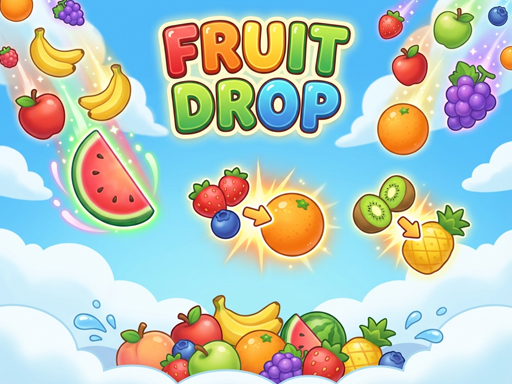
A careful first look at Fruit Drop and its advertised jar puzzle.
A container and a matching idea
Fruit Drop describes dropping fruits into a jar, merging identical fruits into larger ones and seeking a higher score. That is a clearer mechanical outline than a title alone, but it still leaves important details unspecified. The preserved text does not give the sequence of fruit types, the placement gesture, a capacity limit or a complete scoring rule. A familiar-looking fruit illustration cannot fill those gaps reliably.
The description names another game as an inspiration. That comparison helps explain a general genre, but it does not establish identical behaviour. Treat Fruit Drop as its own interface. Read its instructions before importing assumptions about what the largest fruit is, how a merge moves nearby objects or whether any particular action can be reversed.
Separate the intended pair from the landing
If the game allows you to position a drop, think of two questions: which identical fruit are you aiming to meet, and where is the incoming fruit likely to settle? In a hypothetical container puzzle, those answers may differ because other pieces occupy the route. This is a way to organise observation, not a claim about verified physics in Fruit Drop.
After one placement, look for the specific result you intended. Did two identical items meet? Did the game visibly replace them? Did a score change? These observations should remain separate until the game explains how they relate. An animation can show a merge without proving the exact points awarded, and a score change may have a label you have not yet read.
Leave space for a revised explanation
An early guess about the fruit order should be easy to revise. If the game displays a progression chart, use that chart rather than a remembered sequence from an inspiration. If no chart appears, avoid presenting a few observed merges as a complete catalogue. The same caution applies to the jar's apparent fullness: a picture alone does not establish the exact condition that ends a run.
The date on the website's selection does not create a fresh jar or identify a daily score competition. It is only a browsing reference. A useful first session can simply clarify the placement control and one demonstrated merge. That gives a later visit a concrete starting point without a fabricated fruit hierarchy, an untested scoring formula or a promise that the same strategy will work in every state.