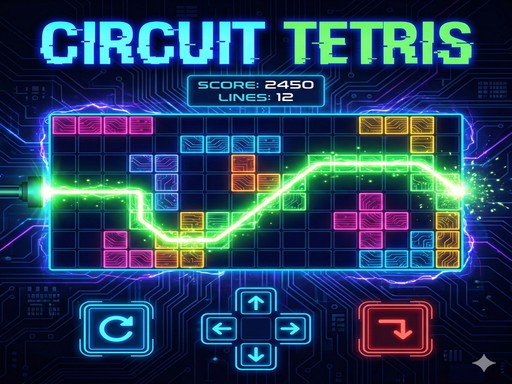
A way to read Circuit Tetris without assuming that every familiar falling-block rule applies.
Start with what the listing names
Circuit Tetris presents falling pieces as parts of a circuit board. Its description mentions descending pieces and rotation, then ends before a complete rule set is given. That wording invites two questions: where can a piece fit, and what does its connection mean? The first concerns space; the second concerns whatever circuit rule the game actually explains. A piece that fits neatly is not automatically a useful electrical connection under an unknown scoring system.
The familiar word in the title can help identify the general falling-block idea, but it should not fill in missing rules. The supplied text does not establish the clearing condition, the meaning of every component, or the existence of a preview queue. Those details need to come from the game's own instructions rather than from a different puzzle with a similar name.
Read a connection before committing
When a game explains connection points, compare those points with the outline of the piece. Imagine a hypothetical elbow-shaped component: its outline might fit a corner while its terminals face unhelpful directions. This example illustrates the difference between geometric fit and functional fit. It does not assert that Circuit Tetris contains that component or uses a particular circuit simulation.
If the interface offers a rotation preview, use it to see how both the outline and any marked endpoints change. If there is no preview, avoid assuming one can be opened with a familiar keyboard shortcut. The listing's Mouse/Touch field is too broad to specify the rotation gesture. An instruction in the loaded game is stronger evidence than a guess based on the title.
Keep the next decision readable
A useful puzzle habit is to preserve a space whose purpose you understand. This need not mean leaving the largest possible empty region. A small gap with a clear connection route may be easier to reason about than a large gap with several incompatible openings. Whether that matters here depends on the rules that are actually shown.
After one placement, ask what changed: a visible connection, an occupied space, a score, or none of those? Do not treat a flash or animation as proof of a completed circuit unless the game identifies it that way. This reading approach keeps the circuit theme meaningful while leaving unverified mechanics unclaimed. The date on Game Rotation remains a browsing aid; it provides no evidence about puzzle updates, balance changes or a tested solution.